8 small things

1
I return continually to the motif of the envelope, in writing, art and life. This is hardly surprising since I chose to utilise my great grandmother’s beautiful WWI envelopes in my book, Vessel, but it’s also true to say that I would never have thought to use them in such a way in my book were it not for literary envelopes I had encountered prior to that. These include the letter from her brother torn up and repeated in various ways throughout the accordion folds of Anne Carson’s Nox, and in conversation with that, Emily Dickinson’s envelope poems as presented in the book The Gorgeous Nothings, by Jen Bervin and Marta Werner. This latter book is especially compelling because it was put together by an Emily Dickinson scholar on the one hand and a visual artist on the other, so that the envelopes in the book form an installation of sorts, as well as a poetics separate from the fragmentary content itself. I came away from these two books (and Susan Howe’s Spontaneous Particulars) with ideas about envelopes and what you might do with them. I happened to possess a pile of rather beautiful old envelopes (though I presented only the backs of the envelopes in Vessel, the fronts, with their copperplate handwriting, are lovelier still).
2
I read once, when I was researching my thesis chapter on Nox, that Anne Carson was proud to have produced a book that she thought ‘un-Kindle-able’. I suppose she meant this primarily in the sense that Nox as a book, is an artifact, and you can’t experience it in the same way in a digital reproduction, if such an edition even exists for this title. Nox, if you don’t already know, is an approximate facsimile of a scrapbook created by Carson. Part of the tactile magic of the book or leoporello contained in a box, is the way it is replicated on the page, the physical marks, deep gouges of frustration and grief, enacted by sharp objects, and other marks on the joined pages. There is an uncanny transparency on others, producing a ghostliness or a sense of what is no longer within reach. And there is the way the dual translations of brothers (Carson’s and the brother of ancient poet Catullus) bleed into each other, as they bleed into their respective endings: untranslatable, unable to be illuminated.
When Nox was published in 2010, Kindle was one thing that an artist/writer might have worried about, though not, I suspect in quite the same existential way we worry about AI in the present. Yet still, I think the kind of book Nox is remains safe from wholesale replication, even as it is itself a copy. So far, AI can’t put a leoporello manuscript in a box and call it a book, not only because it’s not equipped to do so physically, but because it can’t do it conceptually.
This week marks a furore, as most people in the bookish world already know, about a horror novel first self-published and then published by a big five publisher, and finally pulled from publication as it came to light that the book was produced (predicted?) via AI. I only know the barest details about it, what I see online. I wonder why people want to write books that they haven’t …written? Is it just for money?
I digress, I’m uninterested in that particular dialogue as such, but I want to talk about and continue thinking about and participating in forms of writing that AI might find difficult to copy. I do this not only for its own, self-preservational (apparently not a word) sake but because it’s interesting to write this way.
3
Each evening at the end of the shortened day, the baby kookaburra or his mother come to sit in the high fence as I water. I say hello, and the bird stays a few minutes, and I am abundantly grateful for the preciousness of this gift, as long as it lasts. Sometimes, they arrive together. They always announce their arrival with a soft call, not the familiar kookaburra ‘laugh’, and I know to leave what I’m doing, to look for them. The world is increasingly filled with the most heinous of deeds and their consequences, small and large, but there is always something outside of that to turn toward for a momentary consolation. I hope everyone can remember to slow down, take a deep breath or two, and take in the natural world, no matter how tiny its envelope of wonder.
4
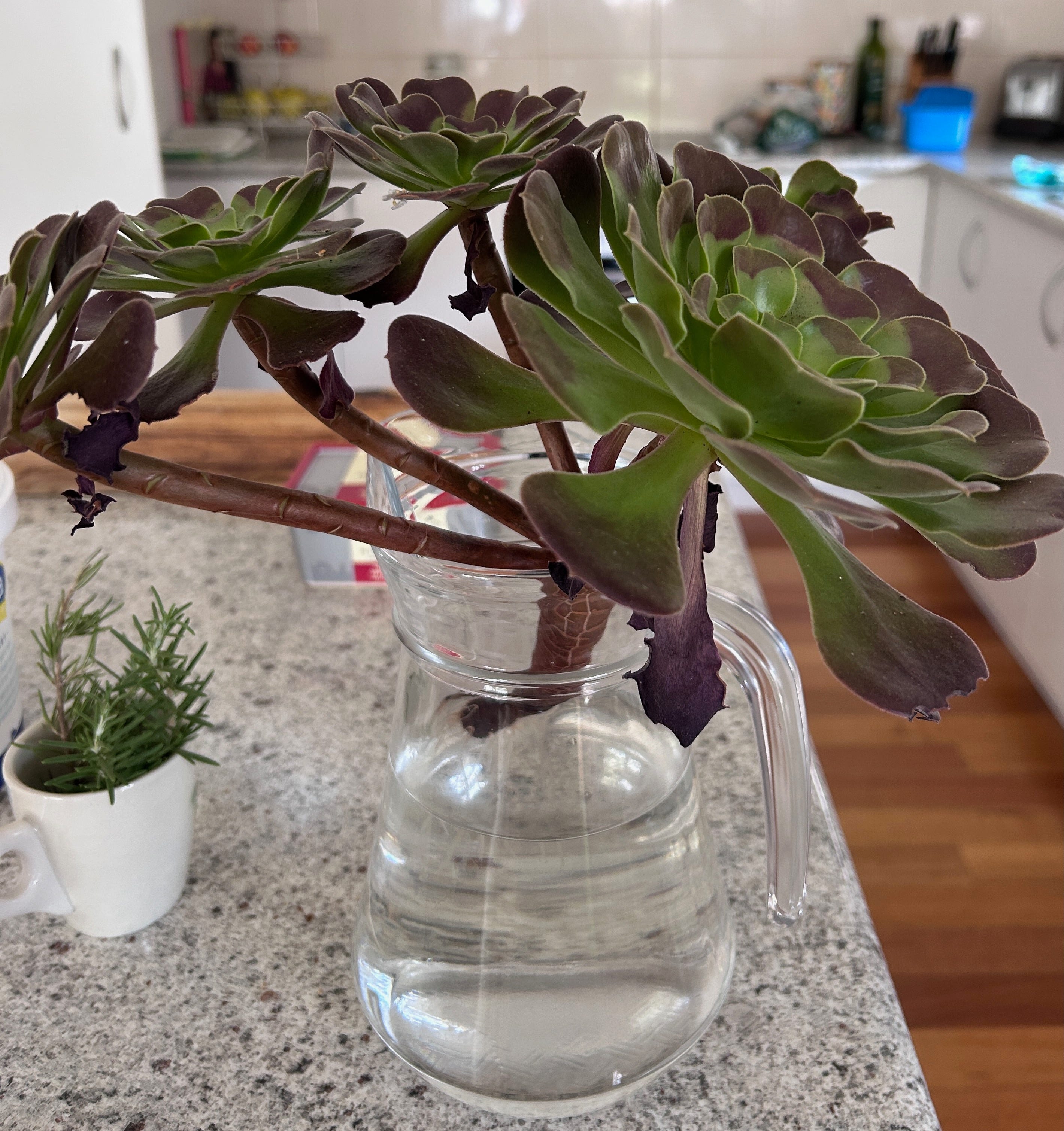
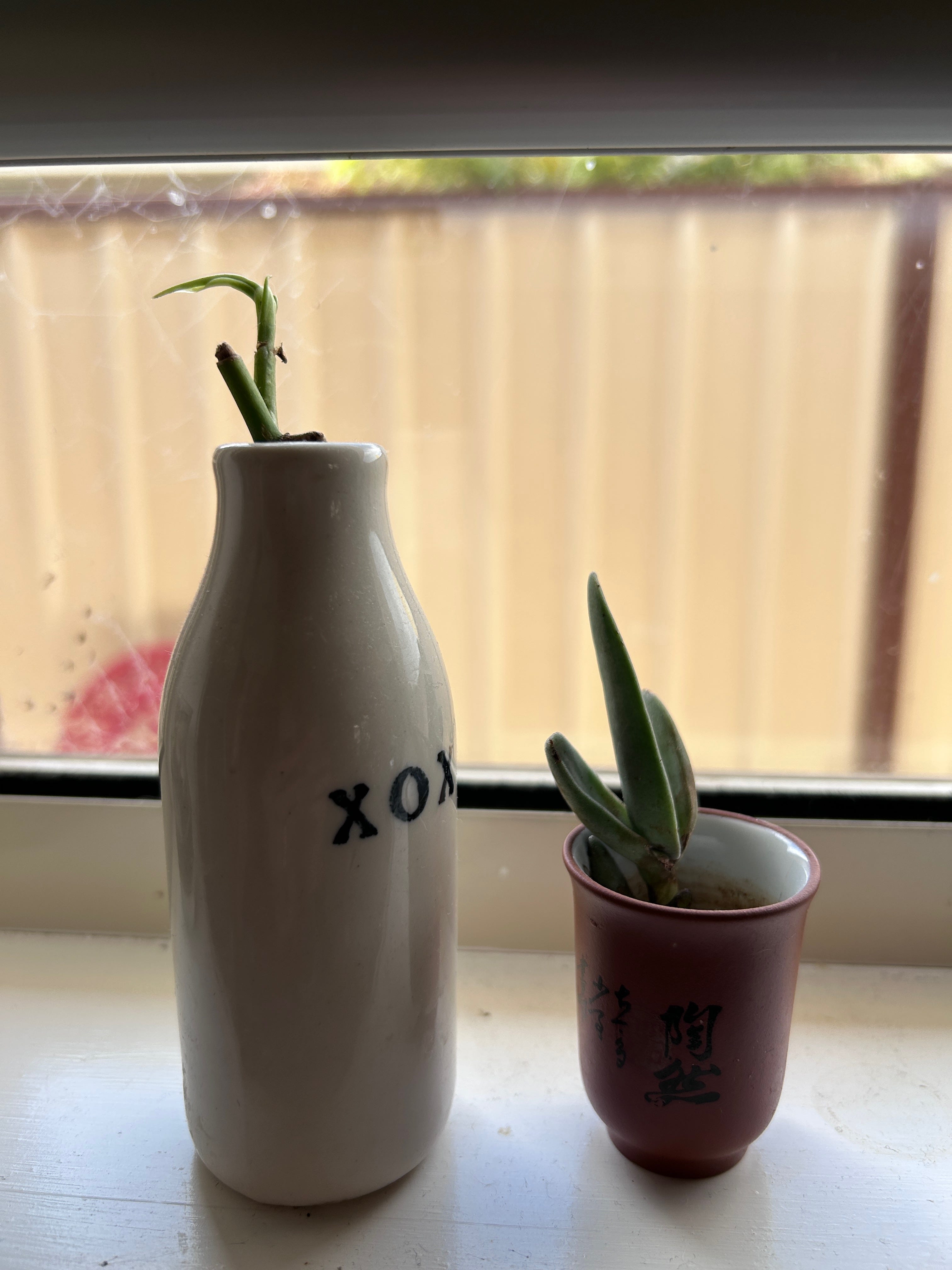
I’m growing things. The two precious succulents are from my mother’s garden, and it makes me happy to see the silken roots growing in water. Soon I will transfer them to pots, though I’m tempted to keep the aeonium in the carafe. And I am drying out all my river hydrangeas to take to my mother’s grave. They were one of her favourite flowers.
5
I’m trying to write this fragmentary book. I’ve only just begun. I have to keep reminding myself of Nox, and of The Gorgeous Nothings, and the ideas behind them, to keep true to the heart of allowing myself to experiment, to not think about what readers want but what I need to write, right now, to get through these hard days. I have to believe in the process, believe in trying, believe I am well qualified to write this book, and that it is in keeping with what I studied so deeply, and what I love. This writing has to sustain me, hold me upright through the storms.
6
I spent about ten days since I was last here, transcribing my mum’s life story. She’s titled it You Come Too… Mum, which is apparently what my older brother said before we left for the irrigation channel in which he and my father drowned. She wrote how much, in some ways, she wished she had, and how she knew she would still be hearing that phrase on her last day before she went to join them again. Reading it as I typed out her words so there would be a digital version that perhaps I’ll end up self-publishing, with added photos for friends and family, I was so immersed, because she brought my father and older brother back to life, along with my grandparents and great grandparents and others. Everyone was back, and I was re-living my childhood. But a cloud hung over the reading. I knew that, as sure as they lived again with these cigarette-smoke-infused pages, they must also die again within them. And they did, and I wept, and imagined my mother’s tears mingled on the page, invisible, with the cigarette smoke.
7
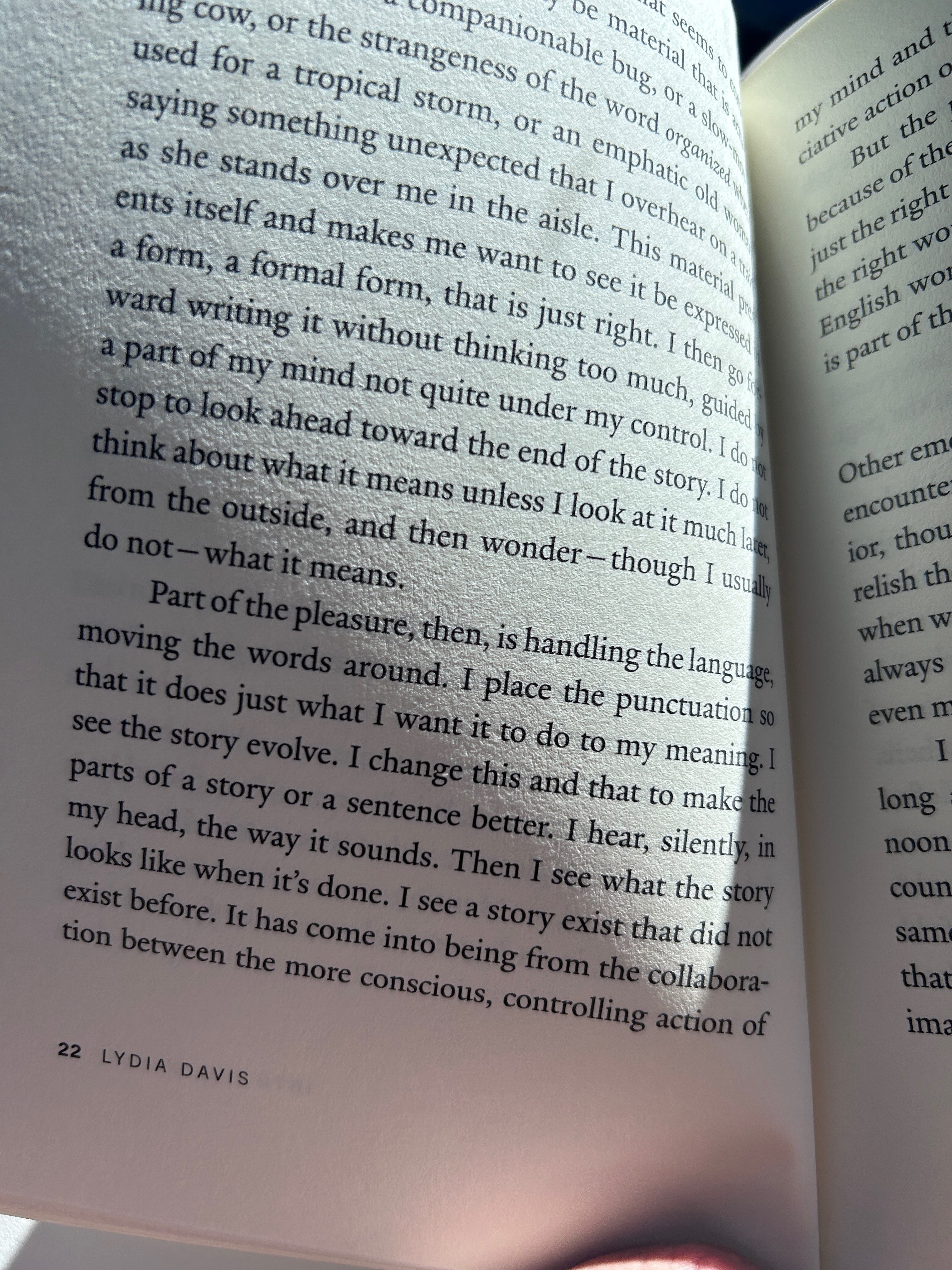
I haven’t been reading much, due to circumstances having to do with my son not sleeping as he adjusts to a new medication, but I finished Heather Christle’s Among the Rhododendrons, and Lydia Davis’s Into the Weeds in a Yale University ‘Why I Write’ series. Davis writes near the beginning, ‘Part of why I write then, is handling the language, moving the words around.’ They’re both good examples of ‘why I read’, because I love to see how people’s minds work. And these are both such good treatises on why AI isn’t the end of creativity.
8
Here’s a description of Nox by Brian Davis, in his paper ‘Instrumentalizing the book’:
‘Anne Carson’s Nox reimagines the book in the digital age by treating print as a multimodal, archival, and deeply personal object—a “grief-work” tool that mimics hypertext through physical, non-linear engagement. It emphasizes materiality—scrapbooking, tearing, and rearranging text—against the immateriality of digital text, making the physical book a unique, interactive experience.’
Sixteen years after its publication, there are many, many great scholarly papers written on Nox. I love that Liedeke Plate’s article ‘How to Do Things with Literature in the Digital Age: Anne Carson’s Nox, Multimodality, and the Ethics of Bookishness’ notes that not much had been written on it when she wrote this article.
And here’s a nice, long video and interview with the makers of The Gorgeous Nothings book. Enjoy, and be well, and may you find some wonderment and respite in your days. Thanks for reading x
I read this in my email but I'm back on Substack today and reading it again. This part - "allowing myself to experiment, to not think about what readers want but what I need to write, right now, to get through these hard days" resonates so completely with me right now. I am grappling with this, in the face of all that is impending. And yet I don't think it's going to get easier.
Thanks for the reminder about Nox - I haven't thought about that for years. I didn't know about The Gorgeous Nothings! It sounds like just what I need today. ♡ x
Edit: Also, I want to add - I was reading the discourse about Shy Girl on LinkedIn, and someone commented with “who cares who writes these books - a good story is a good story”. I shut the tab down and I ached and ached and ached. For all the stories I haven’t had the courage to write, for the words I haven’t published. For the dreams that keep slipping further from my reach with each new global crisis. For my heightened sensitivity and lack of audacity. For the way that creatives are being diminished by consumers who don’t understand blood and tears and craft. Sigh.
So beautiful Dani. This: “You come too… Mum, which is apparently what my older brother said before we left for the irrigation channel in which he and my father drowned. She wrote how much, in some ways, she wished she had, and how she knew she would still be hearing that phrase on her last day before she went to join them again.”
Deep-hearted. Heartbreaking